I was asked for this post to answer the question:
what is the "best" camera? Naturally, as hinted by the quotation
marks hovering around the word best, this was a trick question. There is no
such thing as the best camera, only better cameras - for certain situations. Are
you shooting documentary style footage from a shoulder mount? Or will you set
up a still interview with planned lighting and a tripod? How about shooting underwater?
All of these situations and factors influence what might be considered a “best”
camera, and that camera’s worth is not qualified by its price tag. Surely, a $20,000
Sony F3 is far more expensive than a GoPro, and shoots sharper images from a
tripod, but if you’re trying to get a subjective shot from behind the
windshield of a speeding motorcycle, than the Sony would not be the “best”
camera. Similarly, if you are shooting with only the limited natural light
available to you, and desire to crush the depth of field, a DSLR might be – in that
sliver of a situation – the “best” camera at your disposal. Fortunately, the
stable of TCF Department cameras has equipment that is suited to many different
factors; including mobility, sensitivity to light, the ability to attach prime
versus zoom lenses, size, and on and on… I hope to consistently be able to
choose the “best” camera to use in any given film situation I encounter.
Tuesday, March 20, 2012

Thursday, March 1, 2012
7. An Analysis of Camera Movement
One of the most striking examples of camera movement in recent memory for me was in Gus Van Sant's Elephant. Elephant is the story of a school shooting, partially inspired by the Columbine massacre, that is horrifying in large part because of the juxtaposition of trivial high school life and the life-and-death tragedy of a murderous assault. The camera movement highlights this disconnect between the mundane and the terrible, and lends a sickening element to a movie that is ultimately designed to sicken. In the above scene, a Steadicam tracks behind an unnamed character as he goes about his day. The long, uncut shot is captured in a way that mimics how we see the world: moving steady, at walking pace, directly behind the character. We are brought into an intimate view of his life... lingering at pretty girls in the hallway, following him through fields and doors and corridors as we are given a slice of his life. The camera movement feels so natural as to be almost unnoticeable, and this sets up the entire scene to be broken down. The long, slow, steady follow shots of this character contrast heavily with the rapid firing of bullets and sudden onslaught of bloodshed. This perfectly captures the juxtaposition I mentioned earlier and is a result of intentional, deliberate camera movement at its finest.
In a lighter tone, Gotye's extremely popular music video for Somebody That I Used to Know uses some interesting camera movement in the opening shot. The camera smoothly tracks over the left side of Gotye's body from head to toe. The song contemplates past relationships leading into hurtful breakups, and I love how the initial camerawork reflects the first stages of this emotional and taxing process. The camera slowly explores his body, revealing only a small portion at a time, the same way a lover might learn and become close to you during the whirlwind of meeting. The movement of the camera separates us from truly knowing the whole image of Gotye's body, which works perfectly with the concept of the song.
These two examples of camera movement have given me insight into what makes camera movement effective and what makes camera movement bad. First and foremost, I feel that camera movement must be motivated. This means that there must be a reason, or meaning behind making the camera move a certain way. If the story told by a shot could be better told still, then it should be. If the camera is moved on a dolly, or glidetrack, or steadicam, or anything without having a meaningful reason to, then the movement feels very jarring and unnecessary. The scene just doesn't feel right and the movement can take the viewer out of the story.
Similarly, if the technique of movement is executed poorly, then the camera movement can snatch the audience from the enraptured state of receiving the story. For instance, if the movie is cut so that the beginning of a glidetrack shot is seen, then the audience can subconsciously (or very consciously, if the sudden movement of the camera sliding along the track is obvious enough) realize that "this was shot on a camera". If they become aware of the medium of the work on any level, the suspension of disbelief and depth of the story are compromised. This reminds me a little bit of reading a good book: there comes a point where the reader is not merely "reading the words", but walking through the story in their mind. Every film should strive to do the same, and camera movement should aid this cause rather than negate it.
Thursday, February 16, 2012
6. Shot by Shot Analysis: Up in the Air
At the end of the film Up in the Air, our main character Ryan Bingham experiences a profound crisis. This internal upheaval is translated to the screen by controlled artistic use of the camera - framing, lighting and composition all play a role in subtly painting the story for the audience. The result is one of the most powerful scenes in recent memory.


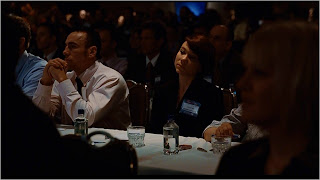


1. The opening shot takes place at a Las Vegas convention center, with Ryan giving his signature presentation at the venue he’s always dreamed of performing. His speech, in essence, highlights the advantages of living without personal connections, of always traveling light – both in physical terms and in terms of relationships. This message sums up his character. The shot reflects this worldview of his – he stands alone, in the center of the frame, without his emotions visible to us since we are looking at his back. In the background, in soft focus and low light, are numerous people. The clearly defined divide symbolizes Bingham’s isolation from the contact that makes life beautiful.

ai
1. However, the next shot stands in contrast. We are allowed a medium close up with ample lighting – and only Bingham in the frame. This allows us to both see the expression on his face (one of defeat and recognition of the sorry state of affairs he has grown himself into) and see visually his recognition of isolation.


1. Soon afterwards the camera guides us back to the audience. In low lighting, with faces in varying degrees of focus, the effect is alienating. These people are strangers, indicated by their number and lack of focus, and they look up at Bingham from the darkness, essentially yearning for answers and validation from his speech. The pressure on him to make his choice – continue speaking and accept what his life has become, or stop and confront his identity crisis – weighs heavy with the tension brought from this shot.

1. The choice is finally symbolized in the next shot. Bingham is positioned in half of the frame, with nothing in particular occupying the half in front of him. He is metaphorically facing and standing up to something he can’t see – his own flawed sense of self.

1. The next shot is tight on Bingham’s face as he rushes off the stage after only a few moments of speaking. His destination: the one woman who he has been able to make a connection with that runs deeper than business. Once again, the faces he runs past are obscured, but for a different reason: they are blurred by his quick movement. The tight framing on his face allows us to see his increasingly mischievous smile as he throws off the yoke of his isolation. The faces are not – unlike the out of focus strangers – obscured to highlight his alienation, they are obscured because of his singular focus to make his only connection. He ignores all else in his pursuit.

1. Similarly, the next shot tracks him running through the airport to make the physical connection (a flight) to his emotional one. From here on out, the travel scenes are consistently left-to-right and serve as an effective transition, taking us away from the sterile convention center and to the lady’s house. The camera goes with Bingham, rather than seeing him run across the frame, to highlight his urgency and to impart that urgency on the audience.

1. The shot of Bingham reaching his gate has a very interesting composition. In it, we see him standing at the very center of the ramp. Outside of that tunnel, light streams through the windows, and down the ramp is a dark pathway. This enhances the sense of Bingham finally leaving his comfort zone. He has always relied on flying as a means to leave relationships behind, as symbolized by the abundant light, and he has used this excuse subconsciously to avoid confronting the possible sadness, love and all emotions of the unknown, represented by the dark pathway. Basically, the shot makes a bold transition for Bingham, and he takes the plunge by stepping through the gate (which has now been made into much more than an airline gate). Unfortunately, the darkness of the gate foreshadows the results of this plunge.

1. Next we are treated to a close shot of Bingham, but his eyes are the only visible part of his face as the light hits them. Notably, the light streams upwards from the ground through the airplane’s window, and his eyes are visible because they reflect that light. This lighting demonstrates, for the first time, Bingham’s longing to reach the light and love of life on the ground and to leave the alienation of his former life in the air.

1. The following shot establishes the setting as he flies into the hometown of the woman he is growing to love, as seen from the sky – an excellent way to show the setting while maintaining Bingham’s perspective.

1. Bingham hurriedly rents a car from the teenager managing the facility. The natural-seeming two shot underscores his increasing relation to other people.

1. Next is another travel shot from left to right. Bingham is placed in the left half of the frame, darkness behind him, light in front. The fact that he is taking control by driving a vehicle rather than being ferried by aircraft, coupled with the lighting, continues to paint his passage through this identity crisis as he begins to steer his life back on track. The directions placed in his hand that we clearly see his eyes flickering back to show us that he is still in an unfamiliar world.


1. The next couple of shots feature an empty neighborhood, with Bingham as a subtly glowing subject hurrying through the fairly shadowed street. The focus on him and his personal crusade remains strong.

1. Finally, he reaches the doorway of her house. He ascends up to the lit, colorful doorway, almost yearning for the life and light that must be contained inside. The shot is completely centered on him and this final barrier, maintaining the utmost focus.

1. The next shot, however, is unsettling – and for a good reason. Yes, Bingham is still in the center of the frame, he is still lit – but the camera is looking down on him from the steps. The power has been taken from him by this positioning, and he looks weak and futile as reality begins to crash down upon his fantasy of reclaiming the love and passion he has missed out on his whole life.


1. The next few shots go back and forth over the shoulder of Bingham and down upon him. The woman, Alex, is framed above him and importantly is never fully exposed by the doorway. She is visible, but only above him, and without breaking the threshold of the door. She metaphorically hides behind the doorframe. Her face grows increasingly forlorn, reflecting this dynamic. She cannot bridge the gap from her life to Ryan’s.

1. We are then treated to a very tight close up of Bingham. This brings maximum emotional impact to the scene as his face falls and he wistfully realizes that his crisis will not end in the way he so desires. We can clearly follow as his eyes sink lower and lower in utter defeat and stiffly hidden pain.

1. The sounds of Alex’s children that caused the divide are finally visible behind her. Ryan’s incredulity and her difficult-to-read sadness are interlaced as they silently come to their conclusions about the other. The shots are continuously tight to convey emotion effectively.


1. As her husband, and thus her “real life” momentarily walk into the frame, the door is literally shut in Ryan’s face. The fact that we see the door from Alex’s side cutting Ryan off visually represents Ryan being cut off from his chance at redemption. The transition is stark and brutal, just like his realization.

1. We next see Ryan sitting in his hotel room. The framing is very intricate: his head is cut off, and our only view of his face is the blurred, indistinct reflection in the hotel window. The effect is heavily depressing: as his alienation from personal relationships manifests itself once more, his own personal image and identity is torn from him. Not only are we, the audience, not granted an emotional view of his face (which reinforces his isolation), but the image in the window reflection does the same for him. This shot is as forlorn as I’ve ever seen. Sprinkled in the image are single-serving liquor bottles, which are brightly lit. The light reflects off the tiny glass bottles clearly, highlighting the fact that Ryan has nobody to share them with. The emphasis on the airport-hotel sized bottles reflect the nature of his old life that he has now returned to: sterile and lonely.

1. This striking, final shot sends a clear message with little need for intricate analysis. Ryan is trapped and isolated in the frame, in a tiny square bubble of light in the midst of a pitch black expanse. His journey of self-discovery thus comes full circle, as he once again becomes as isolated as he ever was.
Thursday, February 9, 2012
5. Reflections at Portrait of a Place
Since I am retroactively writing some of these blog
posts, including this one, I will write this reflection based on the project I
had completed just prior to it: the portrait of a place. At this point in the
course, I had begun to recognize certain strengths and weaknesses I possessed. The
first thing I noticed upon reviewing my footage was that my images were by and
large static. Now, with the tone of
my portrait being melancholy, reflecting on the trapped and confined nature of
mental asylums, static shots were very fitting. However, a few shots with more
motivated camera movement and energy could have added to the diversity of the
piece and granted focus and emphasis on certain elements of my location. My
understanding and execution of camera movement could definitely use some
practice and improvement. However, I was very happy with my ability to express
the tone of the piece with audio, editing, and selection of shots. The use of
the interview overlaid on top of the images worked to bestow a sense of despair
and being trapped that I had initially desired. With lingering, starkly contrasting
shots mingling with the overtly disturbing interview of a suicidal woman, the
concept I had in mind was well translated to the finished product.
Thursday, February 2, 2012
4. Beautiful Lighting

This first image is from New York’s Grand Central
Station, taken around 1935-1941. The reason I find its light to be beautiful
and compelling is the prominence that light takes in the photograph. Instead of
warm pools of light illuminating the subjects, or a blanket of ambient light
granting visibility to everything in the frame, we see powerful shafts of light
striking diagonally through the picture. These well defined, bright columns
seem to almost have a physical presence in the room. What I find beautiful,
however, is the way that this type of light enhances the impact of the photo.
These solid beams bestow a sense of the vastness of the space. Almost like a
measuring stick, they span the great distance from ceiling to floor and we
realize just how enormous this architectural marvel is. Moreover, the powerful
shafts of light conjure up thoughts of god and higher power sending light to
earth, which serve to compare this massive vault (a train station) to another
type: a cathedral. And in a way, this is what this picture depicts: a new
cathedral, worshipping and ushering in a new era of travel and technology. With
this powerful, beautiful light, we can almost hear the echoing taps of shoes on
the floors and feel the hushed, awesome power of such a grand place.

This next image is the painting Impression, soleil levant (“Impression, sunrise”) by painter Claude
Monet. Hailing from the year 1872, this painting differs greatly in both years
and style from the previous photograph, but in a starkly contrasting way. What
I find beautiful about this image is the way the whole frame is almost composed
of and seen through light. What I mean by that is that we see the atmosphere of
the painting as the way light shimmers through the dawn haze, and we see the
water as the reflection of the blood orange sun on its surface, and we see the
boat as a silhouette thrown against a lit backdrop. If it wasn’t for the way
that the painter saw this subject – as a result and property of the light
thrown upon it – it would be an entirely unremarkable landscape. As it stands, the
fact that we cannot clearly see the subjects with artificial, clear lighting
grants an air of mystery and wonder to the painting. Who are these lonely men,
poling along the river? What lies in that land of smokestacks, masts, and
foreboding shapes in the background? Under the watchful eye of the sun, the day
unfolds but not all of it is clearly visible to us. This mirrors the meaning of
sunrise: as a new day dawns, who can say what lies ahead.
Thursday, January 26, 2012
3. Goals and What I Want to do With This
I love talking about, interpreting, and breaking down films. I'm fascinated by all of the subtle touches directors put into their projects to express their story. A good movie can leave such a powerful imprint on you, in a way unique to the medium - in a way different from the stories in books and the like (although I love to read as well). But, to be honest, I lack the technical skills to make the effective stories I love to watch myself. I know only the most basic concepts of lighting and shooting, and have extremely limited knowledge of controlling and influencing the images we capture on camera. In TCF 312, I hope to understand the techniques and equipment of filmmaking in a very real way - not just enough to pass a quiz, but to be completely comfortable with the realities of shooting firsthand. Do I know what I'm going to do with this knowledge? Not really. At 19, I'm not too sure what I want to do after I graduate. Editing, with the power to transform images into storylines and emotions, intrigues me. With my other major being Marketing, using film to create fun and effective commercials also seems like a wonderful job. Maybe I won't end up in the media field at all, and film will simply become a hobby and an enduring interest to me. No matter how I apply the things I take from this class, I'm glad to have the opportunity to understand how people make the things I like and to make them myself.
Also, on a completely different note, I secretly hope to find a way to acquire all of the movies I want to watch. Having Netflix, but only with "Instant Watch", is like being a kid in a candy store. Except all of the good candy is locked up in glass cases and the only treats they have out is old, crappy candy and the cheap, generic candy that you get in those coin machines.
Also, on a completely different note, I secretly hope to find a way to acquire all of the movies I want to watch. Having Netflix, but only with "Instant Watch", is like being a kid in a candy store. Except all of the good candy is locked up in glass cases and the only treats they have out is old, crappy candy and the cheap, generic candy that you get in those coin machines.
Tuesday, January 17, 2012
2. Inspiration
The Life Aquatic is one of my favorite movies, and this scene is representative of it's style as a whole. The whimsical romp through his boat shows us a world that maintains a fantastical, heightened reality yet feels completely lived-in and used. The fourth wall is boldly broken down as our protagonist Steve Zissou shows gives us a documentary tour of his boat - but the cross-section cutaway is of course impossible in real life. I am inspired by how the lines of reality are blurred. The Life Aquatic is a film about a filmmaker making a film while trying to avenge a friend's death caused by one of his films. This scene's documentary style reflects and confuses the layers of the film to create a completely magical world, and that's just the way I like it.
2. The Dark Tower

Although books are not an extremely visual form of inspiration, I'll include Stephen King's The Dark Tower series on this list. Despite King's reputation as a contract writer who produces mindless, repetitive horror stories for quick cash (and maybe that reputation is earned, I've never read any other books by him), this series was amazing. What struck me the most was how long the distance traveled in the novels seemed. By the end of the series, I felt as if I had journeyed for thousands of miles and many months with the characters - a sure sign of an immersive experience.
3. Three Re-imagined Movie Posters


Artist Olly Moss re-imagined these movie posters for the original Star Wars trilogy. What inspires me is how he created such a striking effect with such a minimal style. By using the silhouettes of three iconic characters from the movies, he focuses of the relationships and interactions that have always been the basis of good storytelling. The out of focus, almost "misty" scenes contained by these characters evoke a sense of mystery and drama that we never got with the original posters. Overall, these posters suggest a much more involved, character-driven world than the original "space rock opera" posters ever did (Original).

4. Dream Caused by the Flight of a Bumblebee around a Pomegranate a Second Before Awakening

This Dalí painting inspires me because it depicts a dream world so realistically. Here, the simple act of a bee sting explodes through layers of subconsciousness to become the insane sequence of events in the painting: pomegranate releasing fish releasing tigers releasing a rifle. What I find interesting is how, just like in one's own dreams, this explosion does not seem out of place because of the setting. The spindly-legged elephant and subtly sexual naked body of the dreamer herself placed in the indeterminate landscape of the painting makes the "awakening" seem normal. This is similar to how in dreams, the faces and places change without us ever noticing the impossibility of it all.
5. Up in the Air: Wedding Reception Scene
Up in the Air is undoubtedly one of the most complete movies I have ever seen. Each time I watch it, I notice more and more subtle cues and hints that are part of every scene. One scene in particular jumped to mind when I thought of the movie: the wedding reception. What inspires me here is how certain decisions with how this scene was presented adds to the meaning of the scene. In it, our main character Ryan Bingham is alienated from human connection and at home in the world of travel. He never stops to create relationships, choosing to rather "drop in" at most and focus on his work. But in this scene he attends his sister's wedding reception with the woman he has fallen in love with (although eh may not admit that to himself). For once, we do not hear him talking business or discussing downsizing. The soft music covers up whatever is actually said because it doesn't matter to us - it's between him and her. The scene is so powerful because their closeness is depicted in a way their words could never show. In addition, the warm color tones provide a stark contrast to the rest of the film: the reception seems so distant from the cold fluorescent blues and flat office and airport lighting that Bingham is used to. Finally, "home" - a place of people and warmth - is redefined for him in this once scene.
Subscribe to:
Posts (Atom)